
What happens if appendix bursts
What happens if the appendix bursts? Understanding the risks, symptoms, and survival after appendix rupture
A burst appendix is a medical emergency that requires immediate attention. When the appendix ruptures, it releases infectious materials into your abdominal cavity, leading to life-threatening complications such as peritonitis or sepsis.
Despite advances in modern medicine, many people still wonder — what happens if appendix bursts, how long can you live after your appendix bursts, and can you die from appendicitis?
Let’s take a closer look at what really happens during a ruptured appendix, how to recognize the signs, and why timely surgical care is crucial for survival and recovery.
Understanding the appendix and why it bursts
The appendix is a small, tube-like pouch attached to your large intestine, located in the lower right side of your abdomen. While it doesn’t serve a vital digestive function, it can become inflamed or infected — a condition known as appendicitis.
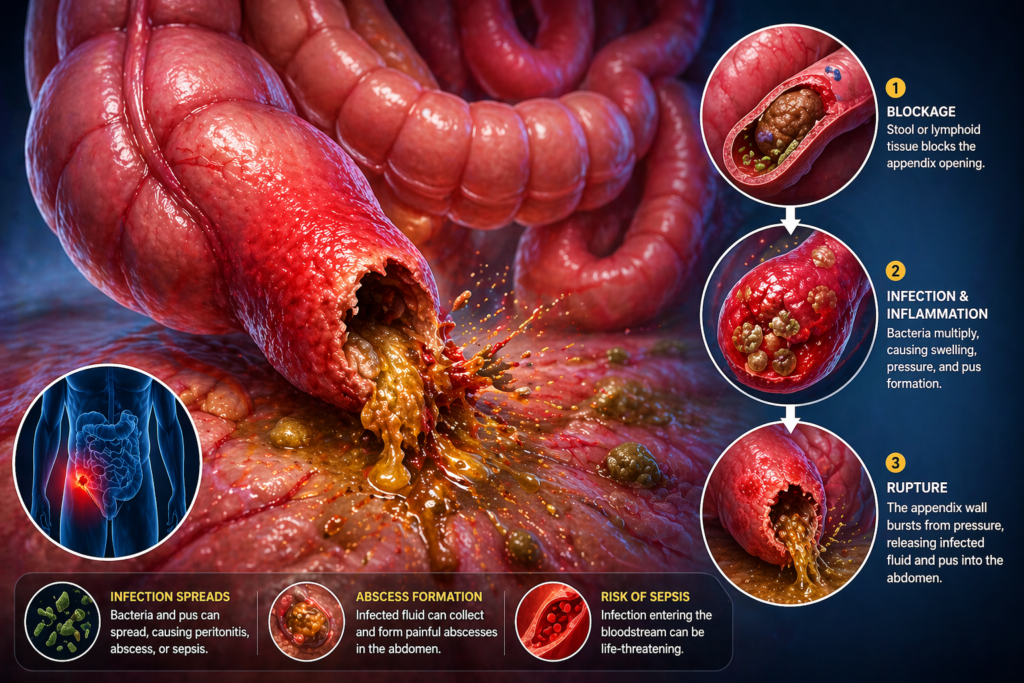
If appendicitis isn’t treated promptly, the infection can worsen, causing the appendix to burst. But why does the appendix burst? The main reason is blockage — usually from hardened stool, swollen lymph tissue, or parasites — that traps bacteria inside the organ. As pressure builds, the appendix becomes swollen, cutting off the blood supply and causing it to rupture.
When the appendix ruptures, bacteria and pus spill into the abdominal cavity, causing peritonitis, a dangerous infection of the abdominal lining. This is why untreated appendicitis is one of the most serious surgical emergencies.
What causes the appendix to burst?
The causes of appendix burst are often linked to delayed medical treatment or misdiagnosis of appendicitis. Common triggers include:
- Blocked appendix opening (due to stool or lymphoid swelling)
- Untreated or unrecognized appendicitis
- Infections in the digestive tract leading to inflammation
- Physical injury or trauma to the abdomen (rarely)
- Certain chronic conditions that weaken immunity
While appendicitis can occur in anyone, it’s more common in people aged 10–30 years. Recognizing early symptoms and seeking timely care is crucial to prevent rupture.
Symptoms of a ruptured appendix
Knowing the symptoms of ruptured appendix can help you act fast. Many people mistake early appendicitis for a stomach bug, which delays diagnosis. However, once the appendix bursts, symptoms escalate rapidly.
Here are the common signs your appendix burst:
- Sudden relief from severe abdominal pain, followed by worsening pain
- High fever and chills
- Nausea and vomiting
- Abdominal swelling or bloating
- Rapid heartbeat
- Difficulty breathing due to abdominal tenderness
- General feeling of weakness or fatigue
If you’re wondering how to tell if your appendix burst, look for the shift from sharp localized pain (usually around the lower right abdomen) to diffuse pain across the belly. This spreading pain is a red flag that infection has spread.
What does it feel like when your appendix bursts?
Before the rupture, patients often report a sharp, stabbing pain near the belly button that moves to the lower right side. When the appendix actually bursts, the pain may temporarily ease — giving a false sense of relief — before returning as intense, widespread discomfort due to infection spreading inside the abdomen.
Many describe it as a deep, constant, and unbearable pain that worsens with movement or touch. The symptoms of ruptured appendix may also include bloating and severe tenderness that makes even light pressure intolerable.
If you experience these symptoms, seek emergency medical care immediately — appendix rupture complications can develop within hours.
What happens when the appendix bursts?
Once the appendix ruptures, infection rapidly spreads in the abdominal cavity. This process can cause:
- Peritonitis – inflammation of the abdominal lining
- Abscess formation – pockets of pus around abdominal organs
- Sepsis – a severe, body-wide infection that can lead to organ failure
So, what happens if appendix ruptures? Essentially, the body’s internal defense is overwhelmed by bacteria from the burst appendix. Without prompt surgery and antibiotics, the infection can turn fatal.
Related Blogs

Appendix rupture complications you should know
Appendix rupture complications can be severe and sometimes long-term. Common complications include:
- Abscess (localized infection): May require drainage through surgery or a tube.
- Sepsis (life-threatening infection): Occurs when bacteria enter the bloodstream.
- Bowel obstruction: Due to inflammation or scar tissue.
- Prolonged recovery and hospitalization: Especially in severe infections.
Even after treatment, patients may experience digestive discomfort or fatigue for several weeks as the body heals.

Can you survive a burst appendix?
One of the most common questions is — can you survive a burst appendix? The answer is yes, but survival depends on how quickly medical intervention is received.
The burst appendix survival rate is high (over 90%) when treated promptly with surgery and antibiotics. However, delayed care increases the risk of sepsis and can significantly lower survival chances.
If you’re wondering how long you can live after your appendix bursts, the window for safe survival is very narrow — typically 24 to 48 hours without treatment before complications become life-threatening.
How to know if your appendix burst
It’s not always easy to know if your appendix has burst, especially if pain temporarily subsides. Here’s how do you know if your appendix burst:
- You initially had appendicitis symptoms that suddenly eased, followed by a new wave of severe pain.
- You experience fever, vomiting, and rapid breathing.
- Your abdomen feels hard, bloated, or tender.
- You feel extremely weak or confused.
If you notice these signs of appendix rupture, seek emergency care — appendicitis can kill you if untreated.
What happens after a burst appendix is treated?
Treatment for a ruptured appendix involves emergency appendectomy (surgical removal of the appendix) combined with strong intravenous antibiotics.
In many modern hospitals, surgeons like Dr. Jagpreet Singh Deed perform laparoscopic or robotic appendectomy, which involves small incisions and faster recovery. This approach minimizes pain, reduces scarring, and allows quicker discharge compared to open surgery.
After surgery, patients are monitored closely for infection. Most recover within 2–4 weeks, though severe cases may require longer hospitalization or additional drainage procedures.
Appendicitis side effects and recovery
Appendicitis side effects after surgery are generally mild but can include:
- Temporary abdominal discomfort or swelling
- Fatigue
- Digestive changes (bloating or constipation)
- Minor wound pain or redness
Following your surgeon’s recovery guidelines — including rest, hydration, and avoiding heavy lifting — ensures a smoother recovery. Laparoscopic and robotic methods, like those performed by Dr. Jagpreet Singh Deed, often lead to faster healing and lower complication rates.
Can you die from appendicitis or a burst appendix?
Many people fear the worst and ask — can you die from appendicitis or can you die if your appendix burst? Unfortunately, yes, if untreated.
Without timely surgery, appendicitis can kill you by causing septic shock or multiple organ failure. However, with prompt diagnosis and modern surgical care, survival rates are excellent. The key lies in recognizing symptoms early and seeking expert care before the appendix ruptures.
Quick takeaways: Signs and risks of a burst appendix
- Severe pain moving from belly button to right abdomen = early appendicitis.
- Pain suddenly eases then worsens = possible appendix burst.
- Fever, nausea, bloating, weakness = medical emergency.
- Treatment: Immediate appendectomy + antibiotics.
- Delay = Life-threatening complications.
Trust Dr. Jagpreet Singh Deed for expert care in appendix and laparoscopic surgery
When it comes to life-threatening emergencies like a ruptured appendix, experience and precision matter. Dr. Jagpreet Singh Deed, Specialist in General and Laparoscopic Surgery, combines over 22 years of global surgical expertise with advanced training from the Cleveland Clinic and the University of Edinburgh.
Renowned for his skill in minimally invasive and robotic oncosurgery, Dr. Deed ensures safe, efficient, and compassionate care for every patient. His mastery in Single Incision Laparoscopic Surgery (SILS) minimizes scarring and speeds recovery — a testament to his commitment to excellence in modern surgery.
Trust Dr. Jagpreet Singh Deed for expert care in appendix and laparoscopic surgery
When it comes to life-threatening emergencies like a ruptured appendix, experience and precision matter. Dr. Jagpreet Singh Deed, Specialist in General and Laparoscopic Surgery, combines over 22 years of global surgical expertise with advanced training from the Cleveland Clinic and the University of Edinburgh.
Renowned for his skill in minimally invasive and robotic oncosurgery, Dr. Deed ensures safe, efficient, and compassionate care for every patient. His mastery in Single Incision Laparoscopic Surgery (SILS) minimizes scarring and speeds recovery — a testament to his commitment to excellence in modern surgery.