
How Do I Check Myself for a Hernia?
You might see a bulge in your abdomen or feel a dull ache that gets worse when you cough or lift something heavy. These early signs are easy to miss, but they could mean you have a hernia. If you’ve ever wondered, “how do I check myself for a hernia?”, you’re not alone. Many people notice these symptoms without knowing what they mean.
Dr. Jagpreet Singh Deed offers expert evaluation and advanced care for all kinds of hernias. Noticing early signs and listening to your body can help you begin treatment sooner and avoid complications later.
What is a Hernia and why does it happen?
Before you learn how to check yourself for a hernia, it’s helpful to understand what a hernia actually is.
A hernia is diagnosed when an internal organ or tissue pushes through a weak area in the muscle or connective tissue surrounding it. Most hernias form in the abdominal wall, making abdominal hernias the most common type.
What causes a hernia?
Hernia often develop when a weak area of the abdominal wall is repeatedly exposed to increased abdominal pressure.
In fact, most risk factors for hernias have one thing in common: they increase pressure inside the abdomen over time. Activities and conditions that can raise abdominal pressure include Conditions and activities that increase abdominal pressure include:
- Heavy lifting without proper support – Repeatedly lifting heavy objects can put excessive strain on the abdominal muscles, increasing the risk of a hernia.
- Chronic coughing – Persistent coughing creates repeated pressure inside the abdomen, which can gradually weaken the abdominal wall.
- Constipation and straining during bowel movements – Frequent straining while passing stool increases abdominal pressure and can contribute to hernia formation.
- Difficulty passing urine or urinary obstruction – Conditions that require straining to urinate, such as an enlarged prostate, can place extra pressure on the abdominal wall over time.
- Obesity – Excess body weight increases constant pressure on the abdominal muscles, making hernias more likely to develop.
- Pregnancy – The growing uterus places additional pressure on the abdominal wall, which can weaken muscles and contribute to hernias.
- Previous abdominal surgery – Surgical incisions can leave weakened areas in the abdominal wall, increasing the risk of an incisional hernia.
- Aging and muscle weakness – As people age, muscles and connective tissues naturally lose strength, making it easier for a hernia to develop.
Over time, repeated increases in abdominal pressure can weaken the abdominal wall and contribute to the development of a hernia.

How can you check for a Hernia at home?
If something feels off, a simple self-check can help you spot possible hernia symptoms. While checking yourself isn’t a substitute for a doctor’s diagnosis, it can help you notice warning signs early.
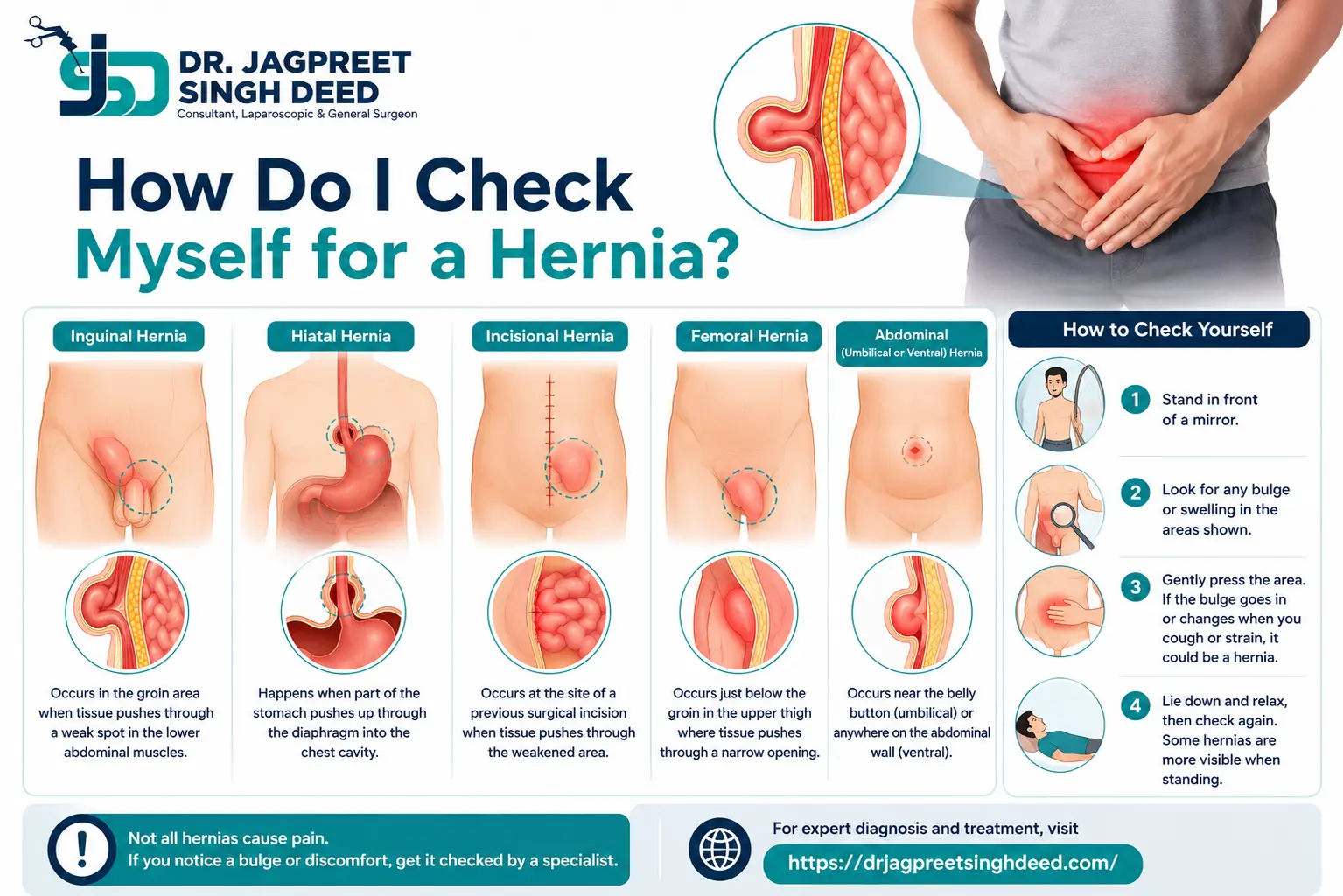
1. Look for a visible bulge
A common sign of a hernia is a noticeable bulge under the skin.
Stand in front of a mirror and examine your:
- Groin area
- Belly button
- Lower abdomen
- Previous surgical incision sites
The bulge might be easier to see when you are:
- Standing
- Coughing
- Sneezing
- Straining
In many cases, the lump goes away when you lie down.
2. Check for pain or pressure
Many people wonder, “what does a hernia feel like?” may feel like:
- You may feel a steady, mild ache.
- Some people experience a burning discomfort.
- You may feel pressure in your abdomen or groin.
- You may feel heaviness after standing for a long time.
- You might feel pain when you lift something or exercise.
Some hernia symptoms remain mild initially, while others become progressively more painful over time.
3. Try the gentle cough test
Place your hand gently over the area you’re concerned about and give a soft cough. If you feel a bulge, movement, or pressure beneath your hand, it may indicate a hernia. This simple check is often used during examinations to help detect certain types of hernias early.
4. Notice changes during physical activity
Symptoms often worsen during:
- Moving your body
- Lifting things that are heavy
- Bending over
- Standing for a long time.
If discomfort consistently increases with physical strain, it may indicate an abdominal hernia.
Common Hernia Symptoms You Should Never Ignore
Recognizing early hernia symptoms can prevent future complications. Some symptoms may appear gradually, while others develop suddenly.
Common signs of a hernia include:
- You may notice swelling or a bulge in your abdomen or groin.
- You might feel pain when you cough or bend over.
- There could be a sense of weakness in your abdominal area.
- A burning feeling may occur near the lump.
- You may experience a feeling of heaviness.
- You might feel pressure after eating or being active.
In severe cases, symptoms may include:
- Nausea
- Vomiting
- Fever
- Sudden intense pain
- Redness around the bulge
If you notice these symptoms, get medical help right away.
Related Blogs
What are the types of Hernia
There are several types of hernias, each affecting a different part of the body.
- Inguinal Hernia
This is the most common type, especially in men. It happens in the groin area and can cause discomfort when walking or lifting. - Hiatal Hernia
A hiatal hernia occurs when part of the stomach moves upward through the diaphragm. It often causes acid reflux and chest discomfort. - Incisional Hernia
This type develops where you’ve had abdominal surgery before, because the tissue there is weaker. - Femoral Hernia
Femoral hernias are less common but can be more serious. They usually show up near the upper thigh. - Abdominal (Umbilical or Ventral) Hernia
An abdominal hernia happens when tissue pushes through a weak spot in the abdominal wall. Also known as umbilical hernia, which develops around the belly button and is frequently identified on ultrasound examinations. These hernias often cause a visible bulge and discomfort that may worsen with coughing, lifting, or straining.
Understanding the different types of hernia helps patients identify symptoms earlier and seek appropriate treatment.
What does a Hernia feel like over time?
One reason many people delay treatment is that hernia symptoms may come and go initially. However, untreated hernias rarely heal on their own.
Over time, patients often report:
- Increasing discomfort
- Enlarging bulge
- Difficulty exercising
- Pain during daily activities
- Digestive discomfort
If you keep wondering, how do I check myself for a hernia? Because your symptoms won’t go away, it’s time to see a doctor.
When should you see a specialist?
A self-check can give you some clues, but it can’t confirm a diagnosis. If you keep noticing signs of a hernia, see a specialist as soon as possible.
You should seek medical care if:
- The bulge grows larger
- Pain becomes severe
- Symptoms interfere with daily life
- The lump becomes hard or tender
- You experience nausea or vomiting
Dr. Jagpreet Singh Deed, provides accurate diagnosis and advanced treatment options for all types of hernias.
How Hernias are diagnosed
Dr. Jagpreet Singh typically diagnoses hernia conditions through:
- Starting with a physical examination.
- Review the patient’s medical history.
- Perform an ultrasound as the next step.
- dUndergo a CT scan if further imaging is needed.
Use MRI imaging for more complex cases.
Finding a hernia early can help prevent serious problems like strangulation, which happens when blood flow to the tissue is blocked.
Can a Hernia go away without treatment?
One common myth about hernias is that they can heal on their own. Unfortunately, hernias do not resolve on their own. Lifestyle changes may temporarily reduce discomfort, but surgery is often the definitive treatment for most hernias.
Ignoring signs of a hernia can lead to:
- Worsening pain
- Enlarged hernia
- Digestive complications
- Emergency surgery
Getting medical help early usually means a quicker recovery and better results.
Tips to Reduce Hernia Risk
Not all hernias can be prevented, but you can lower your risk by:
- Try to keep your weight within a healthy range
- Be careful to avoid straining yourself when lifting heavy objects
- Take steps to treat a chronic cough if you have one
- Eat foods high in fiber to help prevent constipation
- Work on strengthening your core muscles in a safe way
- Consider quitting smoking for better health
These steps can help lower pressure in your abdomen and keep your muscles healthy.
Hernia Treatment Options
If non-surgical treatments do not help with symptoms, surgery is often the best way to get long-term relief. Dr. Jagpreet Singh Deed offers advanced surgical treatment options for all types of hernias.
Type of Hernia | Treatment Options |
• Open hernia repair or laparoscopic repair with mesh reinforcement • Recommended to prevent enlargement and complications | |
• Open repair or laparoscopic mesh repair • Often advised if symptomatic or increasing in size | |
• Surgical repair (open or laparoscopic approach) • Mesh reinforcement to reduce recurrence risk | |
• A minimally invasive laparoscopic procedure where the stomach is wrapped around the lower esophagus to help prevent acid reflux. • Helps control acid reflux and restore stomach position | |
• Open or laparoscopic mesh repair based on the size of the hernia. • Robotic repair can be considered for more complex cases. | |
• Open, laparoscopic, or robotic mesh repair • Choice depends on hernia size and patient condition |
FAQs
Check for a visible bulge, try a gentle cough test, and pay attention to any discomfort when you stand or lift. Still, only a healthcare professional can give you a definite diagnosis.
In the early stages, you might feel mild pressure, burning, heaviness, or aching around your abdomen or groin.
Lifting heavy things, being overweight, coughing a lot, constipation, or waiting too long to get help can make a hernia worse.
Not always. Some abdominal hernias cause little discomfort at first, but others can become painful over time.
The most common hernias are inguinal, umbilical, hiatal, femoral, and incisional types.
Don’t Ignore the Signs of a Hernia. Get Expert Care with Dr. Jagpreet Singh Deed
If you’ve been wondering, “how do I check myself for a hernia?”, begin by tuning in to your body’s signals. Even a small bulge or mild discomfort can matter, as hernias can worsen over time if left untreated. For an accurate diagnosis and personalized care, you can rely on Dr. Jagpreet Singh Deed for advanced, compassionate hernia treatment in Sharjah and care.